
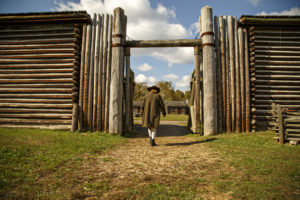
In 1798, when John Miller, a veteran of the Revolutionary War battle of Yorktown, stumbled upon a slice of the Kentucky Bluegrass Region rich with good spring water and excellent soil, he did the only natural thing. He settled there, naming the spot Richmond in honor of his Virginia birthplace. Initially, it didn’t much resemble its gracious namesake city, with Miller’s barn serving as the first courthouse. Richmond has come a long way in its 226 years. As Kentucky’s seventh largest city, it’s a leader in higher education (Eastern Kentucky University); a cultural bulwark (with the highly acclaimed EKU Center for the Arts), and recognized for its natural beauty (surrounded by the foothills of the Appalachian Mountains.) However, Richmond is also known for its compelling history, particularly regarding the early exploration of Kentucky and the Civil War period. Today’s visitors can see tangible reminders of this history. Fort Boonesborough: Picture a summer day at Fort Boonesborough. Sunshine dapples the log cabins and throws shadows across the fort’s central common. A blacksmith, sweat trickling down his face, labors over his forge. A girl, dressed in a simple homespun frock, totes a pail of water. A group of men and women, some decked out in colonial finery and others in frontier buckskins, are deep in conversation. The only clues that a casual observer has that this is 2024 and not 1775 is that one of the pioneer women chats on a cellphone, and several vacationing children are prevented from scaling the fort’s walls by their parents. But imagine this is 1775. Even before John Miller there was Daniel Boone. The intrepid explorer had already made one unsuccessful foray into Kentucky before founding the commonwealth’s second oldest settlement. Fort Boonesborough today may be a Kentucky State Park and National Historic Landmark and the pioneers, costumed re-enactors, but in the 18th century, the rude fort served as a bastion of civilization on a bloody frontier. It was during the spring of 1775 that Boone and his party reached the lofty palisades of the Kentucky River and decided it would be a good spot for a permanent settlement. The river was a source of water and the fertile Bluegrass was ideal for farming and raising livestock. But knowing that the area, called Kan-tuck-ee by the Shawnee, was used by the tribe as a hunting ground, they constructed a fort that would serve both as a temporary residence for settlers while they built their own homes, and as protection against the Shawnee. The layout of the original fort was a rectangle of 26 crude cabins running parallel to the river, with blockhouses anchoring each of the fort’s four corners. It proved a durable design as Fort Boonesborough withstood several major Indian attacks, including a 13-day siege where settlers held off a combined force of 400 Indians and 12 of their French allies. Though the fort was occupied for less than 50 years, it looms large in Kentucky history – serving as a fortress for settlers pouring through the Cumberland Gap along the Wilderness Road. As the frontier pushed further west, Fort Boonesborough was abandoned and remained a neglected remnant of Kentucky’s pioneer past. The general deterioration was compounded by the construction of a lock on the river in the early 20th century, causing half of the original fort to be washed away. The state began an ambitious restoration effort in 1974, and today visitors not only see the fort as it was in Boone’s time, but can interact with resident artisans such as blacksmiths and potters whose demonstrations offer a taste of 18th century pioneer life. White Hall State Historic Site: In the years leading up to the Civil War, one remarkable man took a prominent position on the American stage….and he was from right here in Richmond. Cassius Marcellus Clay first took to rabble-rousing as a firebrand college student at Transylvania in Lexington and later at Yale where after hearing a speech by abolitionist William Lloyd Garrison, he began promoting his emancipationist ideas. Throughout his long life (he lived to be 93), Clay played many roles – lawyer, politician, newspaper editor, foreign emissary, a founding member of Kentucky’s Republican Party, and wealthy planter. The planting was done at his family’s elegant Italianate villa White Hall, now a Kentucky State Historic Site. The sheer size of White Hall – 44 rooms on three floors – surprises first-time visitors until they learn that the mansion is actually two houses in one. The first, Clermont, was built by Clay’s father General Green Clay in 1799; the second, called White Hall, was added in the 1860s by Cassius, who became known as “the Lion of White Hall.” It was to become the scene of many of his triumphs. Today, visitors can admire the china in the dining room, part of a 104-piece set that Clay used for entertaining while serving as Minister to Russia during Abraham Lincoln’s administration. An upstairs bedroom was used by Clay’s daughter Laura, a prominent suffragette and the first woman to have her name placed into nomination for president (at the 1920 Democratic National Convention). The third-floor hallway contains a glass case displaying the True American, the newspaper Clay started when other papers refused to publish his anti-slavery views. But White Hall was also the scene of many of his peccadillos. The Drawing Room must have echoed with the heated arguments of Clay and his first wife Mary Jane when, upon his return from Russia, he discovered that she had not only spent the $8,000 he had left her to refurbish the house, but an additional $22,000 as well. For her part, she was more than a little suspicious of the young boy that her husband had “adopted” during his stay at the Russian court. It was in the library that 89-year-old Clay, clad in his nightshirt, sat reading when three men broke in and interrupted his reverie with mayhem in mind. Never one to do anything by halves, Clay shot one, stabbed another, and impressed the third man enough with his physical prowess that he turned tail and ran. White Hall is now managed by Eastern Kentucky University, and is open for tours April through October. Battle of Richmond Battlefield:
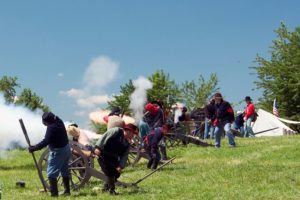
During two sweltering days (August 29 and 30, 1862) when the temperature was in the 90s and Richmond in the midst of a four-month drought, a battle was fought between Union general William “Bull” Smith’s mostly inexperienced troops and Major General Edmund Kirby Smith’s well-seasoned Confederate troops who had fought at Shiloh in Tennessee some four months earlier. Experience proved to be the deciding factor in the battle’s outcome, and with 5,353 total casualties for the Union Army against 451 for the Confederates, the Battle of Richmond was the most lop-sided victory for either side of the entire Civil War. The first major battle in the Kentucky campaign, the Battle of Richmond took place on land where the Blue Grass Army Depot now stands To date, 365 acres of the Richmond Battlefield have been preserved by the American Battlefield Trust, and history buffs will find much to see here. Start with the stately brick Federal-style Rogers House. During the battle, Federal troops bivouacked here, and it’s believed that Union Brig. Gen. Mahlon Manson used it as his headquarters. Today, it houses the Visitors’ Center and a small, but comprehensive and informative museum about the battle. While the Union Army appropriated the Rogers House, Confederate forces did the same at Pleasant View, another Federal-style home at the center of the battlefield. They used the property within 200 yards of the home to outflank the Union forces. Today, the house still shows scars from artillery damage. Picturesque Mt. Zion Church proves to be the favorite of many visitors to the battlefield. The church, which still has an active congregation, was used as a Union field hospital and the same pews worshipers sit on today served as beds for wounded soldiers awaiting surgery. Not many cities can claim a history that features a fort built by one of America’s most famous explorers; a plantation owned by one of the country’s most colorful political figures, and a battlefield that saw the most decisive Confederate victory of the Civil War. Finally, if you want to check out another slice of Richmond’s history, ask for directions to the marker that honors frontier scout and explorer Christopher “Kit” Carson. He may have made his name and gained his fame in the New Mexico Territory – a far cry from the Kentucky Bluegrass Region – but he was born right here in Richmond on Christmas Eve in 1809. For more information on Richmond’s history and its historical attractions, go to visitrichmondky.com